Cells do not exist in isolation. Inside the human body, they constantly interact with their surrounding environment, including neighboring cells, biochemical signals, mechanical forces, and the extracellular matrix (ECM).
The ECM provides more than structural support. It influences how cells attach, grow, migrate, differentiate, and respond to external signals.
Recreating this complex environment is therefore an important challenge in developing advanced in vitro models.
Today, researchers are using biomaterials and engineered scaffolds to mimic key properties of the ECM and create cellular environments that more closely resemble human tissues.
What Is ECM Mimicry?
ECM mimicry refers to the development of materials that reproduce selected structural, mechanical, and biochemical characteristics of the natural extracellular matrix. Natural ECM is highly complex and varies between tissues. The matrix surrounding skin cells, for example, is very different from the environment surrounding neurons or muscle cells. Because of this diversity, researchers do not necessarily try to reproduce the entire ECM. Instead, they design biomaterials with specific properties that are relevant to the tissue or biological process being studied.
These materials can provide cells with a three-dimensional environment while also influencing their behavior through physical and biochemical cues.
How Do Biomaterials Mimic the ECM?
Different biomaterials can be engineered to reproduce different aspects of the cellular microenvironment.
Hydrogels are widely used because their high water content and soft, three-dimensional structure can resemble aspects of natural tissue environments. They can also be modified to control properties such as stiffness, porosity, and cell adhesion.
Natural biomaterials, including collagen, gelatin, fibrin, and hyaluronic acid-based materials, can provide biologically relevant signals because they are derived from or inspired by components of native ECM.
Synthetic biomaterials offer greater control over composition and mechanical properties. Researchers can modify their structure to create specific experimental environments and improve reproducibility.
By combining these approaches, biomaterials can be tailored to support different cell types and tissue models.
Why Does the Cellular Microenvironment Matter?
The physical environment surrounding a cell can significantly influence its behavior.
Cells sense properties such as matrix stiffness, surface structure, biochemical signals, and mechanical forces. These signals can affect cell shape, gene expression, proliferation, differentiation, and tissue organization.
For example, cells cultured on a rigid plastic surface may behave differently from cells embedded within a softer three-dimensional matrix.
This is one reason why simply placing human cells in a culture dish may not always reproduce the conditions found in native tissue.
By introducing an engineered microenvironment, researchers can study cellular responses under conditions that are closer to human physiology.
Applications in Human-Relevant Research
ECM-mimicking biomaterials are increasingly used across a wide range of research applications.
In tissue engineering, they can provide structural support for cells while encouraging tissue organization.
In 3D cell culture, biomaterials can help create environments where cells interact in three dimensions rather than growing only on a flat surface.
In organoid research, ECM-like materials can support the growth and organization of complex cellular structures.
Biomaterials are also useful in drug discovery and toxicology, where more physiologically relevant cellular environments may help researchers obtain a better understanding of how cells respond to compounds.
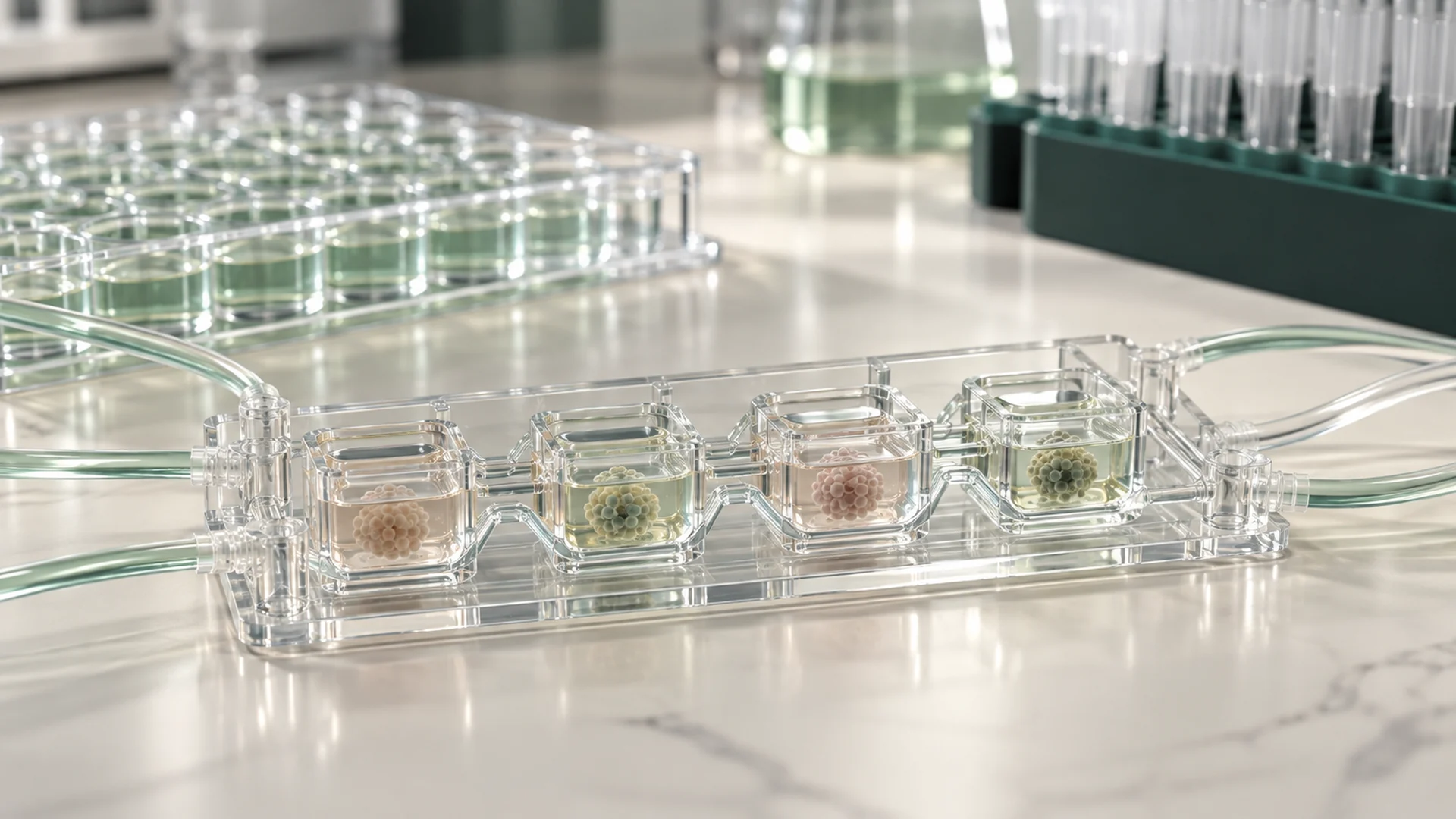
They can also be combined with organ-on-chip and Microphysiological Systems (MPS) to reproduce specific tissue interfaces and mechanical environments.
Designing the Right Biomaterial
There is no universal biomaterial that can perfectly reproduce every human tissue environment.
Researchers must consider several factors when designing an ECM-mimicking system, including:
- Mechanical stiffness
- Porosity and permeability
- Cell adhesion
- Degradation rate
- Biochemical composition
- Cellular compatibility
- Reproducibility
The ideal properties depend on the biological question and the tissue being modeled.
For example, a biomaterial designed for a neural model may require very different mechanical and biochemical characteristics from one intended for cartilage or intestinal tissue.
This makes biomaterial design an important part of developing reliable human-relevant models.
The Future of ECM Mimicry
The next generation of biomaterials is moving toward increasingly sophisticated and dynamic systems.
Researchers are developing tunable hydrogels, engineered scaffolds, decellularized matrices, and biofabricated materials that can reproduce multiple aspects of the cellular microenvironment.
Advanced manufacturing techniques such as 3D bioprinting may also allow researchers to control the spatial organization of cells and biomaterials with increasing precision.
The integration of ECM-mimicking materials with organoids, iPSCs, organ-on-chip platforms, advanced imaging, and computational analysis could create increasingly complex human-relevant models.
The goal is not simply to make cell culture more complicated. It is to create an environment in which cells behave in a way that is more representative of human tissue.
Building More Relevant Cellular Environments
The extracellular matrix plays an essential role in regulating cellular behavior, making the cellular microenvironment a critical factor in advanced in vitro research.
Through engineered biomaterials and ECM-mimicking scaffolds, researchers can recreate important physical and biological cues that are missing from conventional culture systems.
As these technologies continue to develop, combining biomaterial engineering with 3D culture, organoids, organ-on-chip technologies, and MPS may provide increasingly realistic platforms for studying human biology.
ECM mimicry is therefore becoming an important piece of the transition toward more predictive and human-relevant in vitro research.