Developing a new drug requires more than demonstrating that a compound can produce a biological effect. Researchers also need to understand what happens to a drug after it enters the body.
How is it absorbed? Where does it go? How is it metabolized? How long does it remain active? And how is it eliminated?
These questions are at the heart of pharmacokinetics (PK).
Traditionally, pharmacokinetic studies have relied heavily on animal models and increasingly complex experimental systems. However, differences between animal and human physiology can make it difficult to accurately predict how a drug will behave in humans.
Advances in human-relevant in vitro models are creating new opportunities to investigate drug behavior earlier in the development process.
What Is Pharmacokinetics?
Pharmacokinetics describes what the body does to a drug over time.
It is commonly summarized by four fundamental processes:
- Absorption – how a drug enters the body
- Distribution – how it moves through tissues and biological compartments
- Metabolism – how it is chemically modified, primarily by metabolic organs such as the liver
- Excretion – how the drug and its metabolites are eliminated
Together, these processes determine the concentration of a drug in the body and influence both its effectiveness and safety.
Understanding these processes is essential when selecting drug candidates and determining appropriate dosing strategies. In vitro models do not reproduce whole-body pharmacokinetics on their own. Instead, they allow specific components of ADME, such as permeability, transport, metabolism, and tissue-specific interactions, to be investigated under controlled experimental conditions.
Why Study Pharmacokinetics In Vitro?
Traditional in vitro experiments often focus on specific biological effects, such as whether a compound kills cancer cells or activates a particular receptor.
However, drug behavior is much more complex than a single cellular response.
A compound may need to cross biological barriers, interact with proteins, undergo metabolism, and reach specific tissues before producing its intended effect.
Human-relevant in vitro models can recreate selected aspects of these processes under controlled laboratory conditions.
They allow researchers to investigate drug transport, metabolism, permeability, and toxicity while using human cells and tissue models.
These systems can therefore complement conventional approaches and provide additional information before or alongside more complex studies.
Why Study ADME Processes In Vitro?
Different in vitro models can be used to investigate specific components of ADME and drug–tissue interactions.
Cell-based barrier models can be used to study how compounds cross biological interfaces such as the intestinal or blood-brain barrier.
Liver models are particularly important for investigating drug metabolism. Primary human hepatocytes, stem-cell-derived hepatocyte-like cells, organoids, and advanced liver models can help researchers study metabolic activity and potential drug-induced toxicity.
Kidney models can provide information about renal transport and mechanisms involved in drug elimination.
More advanced systems can connect multiple tissues to investigate interactions between different organs.
This is where technologies such as organ-on-a-chip and Microphysiological Systems (MPS) become particularly interesting.
From Individual Organs to Connected Systems
The human body does not process drugs one organ at a time.
A compound absorbed through the intestine can enter circulation, reach the liver, undergo metabolism, interact with other tissues, and eventually be eliminated through the kidneys.
Recreating these interactions in vitro is challenging.
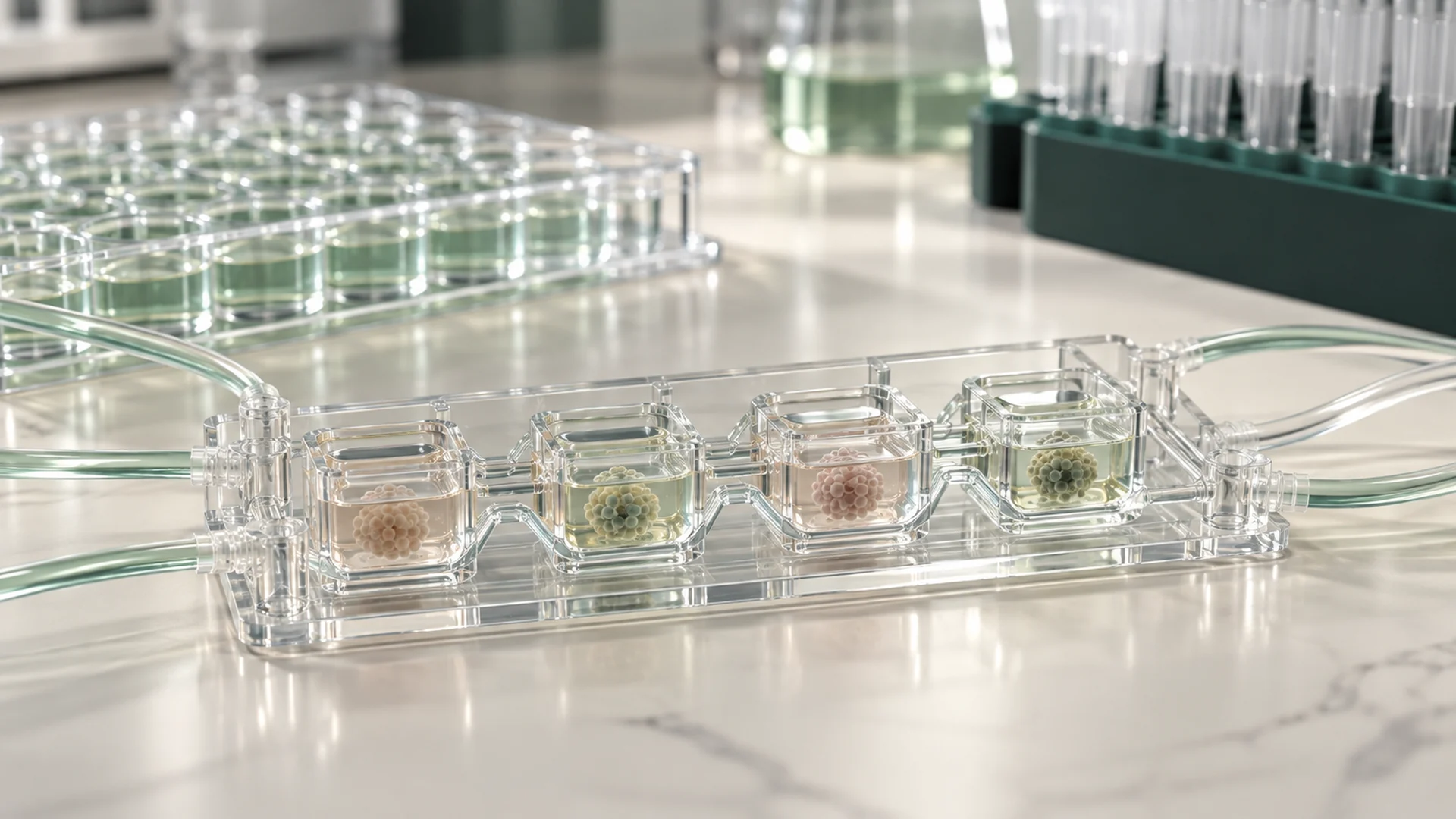
Multi-organ systems aim to address this challenge by connecting different human tissue models through controlled microfluidic environments. These systems can provide a more dynamic representation of how tissues interact with one another.
For example, an intestine-liver model can be designed to investigate how an orally administered compound is absorbed and subsequently metabolized.
Such approaches may provide additional insight into interactions.
Applications in Drug Discovery
In vitro pharmacokinetic models can support several stages of drug development.
During early drug discovery, researchers can compare compounds based on properties such as permeability, metabolic stability, and potential toxicity.
During preclinical development, more advanced human cell models can help investigate how candidate compounds interact with specific tissues.
These models can also be combined with pharmacodynamic studies to explore the relationship between drug exposure and biological response.
Importantly, in vitro systems are not intended to reproduce every aspect of human pharmacokinetics perfectly. Instead, they can provide targeted information that helps researchers make better-informed decisions throughout the development process.
Challenges and Future Perspectives
Developing reliable in vitro pharmacokinetic models remains challenging.
Human physiology involves complex interactions between organs, blood flow, metabolism, transport mechanisms, and biological barriers. Reproducing all of these factors within a laboratory system requires careful model design.
Other challenges include differences between cell sources, model maturity, reproducibility, scalability, and standardization.
Nevertheless, technologies are advancing rapidly.
The combination of human cells, organoids, microfluidics, MPS, and advanced analytical technologies could provide increasingly detailed information about drug behavior.
Rather than relying on a single experimental model, future research may use interconnected systems that provide complementary information about different aspects of pharmacokinetics.
Toward More Informative ADME Research
Pharmacokinetics is fundamental to understanding how drugs behave in the human body, but accurately predicting these processes remains a major challenge in drug development.
Human-relevant in vitro models provide valuable tools for investigating specific processes involved in ADME, including permeability, transport, metabolism, and tissue-specific responses, under controlled experimental conditions.
From individual tissue models to connected organ-on-chip platforms and Microphysiological Systems, these technologies are expanding the possibilities for studying drug behavior outside the body.
As these models become more advanced and standardized, human-relevant in vitro approaches may play an increasingly important role in supporting drug development and improving the prediction of human responses.